

Sustainability · 2025
In this section52 topics
- Sustainability Policy3 items
- Sustainability Goals & UN SDGs3 items
- Policy Review2 items
- Business Value Chain1 item
- Stakeholder Analysis1 item
- Environmental Policy & Guidelines4 items
- Environmental Policy Review1 item
- Energy — Plan & Guidelines3 items
- Energy — Electricity Consumption1 item
- Energy — Fuel Consumption1 item
- Energy — Targets2 items
- Energy — Performance & Outcomes2 items
- Water — Plan & Guidelines3 items
- Water — Withdrawal, Discharge & Consumption1 item
- Water — Targets2 items
- Water — Performance & Outcomes2 items
- Waste — Plan & Guidelines3 items
- Waste — Generation, Disposal & Recycling1 item
- Waste — Targets2 items
- Waste — Performance & Outcomes2 items
- GHG — Plan & Guidelines3 items
- GHG — Emissions1 item
- GHG — Emissions Verification3 items
- GHG — Principles & Standards1 item
- GHG — Targets1 item
- GHG Targets — Net Zero1 item
- GHG Targets — Carbon Neutrality1 item
- GHG Targets — Other Targets1 item
- GHG — Performance & Outcomes2 items
- Environmental Legal Incidents1 item
- Other Environmental Management1 item
- Social Policy & Guidelines3 items
- Social Policy Review1 item
- Social — Principles & Standards Practised1 item
- Human Rights Due Diligence2 items
- Employees — Plan & Guidelines3 items
- Employees — Workforce1 item
- Employees — Remuneration & Provident Fund1 item
- Employees — Training & Development1 item
- Employees — Occupational Health & Safety1 item
- Employees — Labour Relations1 item
- Employees — Employee Representation2 items
- Employees — Targets2 items
- Employees — Performance & Outcomes2 items
- Customers — Plan & Guidelines3 items
- Customers — Satisfaction Results1 item
- Customers — Targets2 items
- Customers — Performance & Outcomes2 items
- Community & Social — Plan & Guidelines3 items
- Community & Social — Targets2 items
- Community & Social — Performance & Outcomes2 items
- Law Violation Incidents1 item
Sustainability Policy
Has a Sustainability Policy
Yes
Policy Description
Since the Company’s establishment and operation in real estate development, LPN has prioritized and focused on working responsibly towards the environment and society in every process and stage. This is to mitigate and reduce impacts that may arise on the environment and society while appropriately caring for stakeholders, following the management approach for organizational sustainability under the LPN Platform 3-6-8-10, which has been continually refined and developed over more than 37 years.
The company implements the principles of sustainable development (Triple Bottom Line) that emphasize three crucial components : Environment (Planet), Society (People), and Governance (Profit), or ESG. This forms the basis for setting goals under the 6 GREEN LPN strategy, which includes :
1. Green Enterprise : Organizational management strategy focusing on sustainable growth.
2. Green Financial Management : Effective financial management strategy considering balanced returns for
all stakeholder groups.
3. Green Marketing Management : Marketing strategy that emphasizes product quality and ethical business
practices, focusing on delivering products as per contracts and commitments made to customers.
4. Green Design Concept : Design strategy that takes the environment into consideration.
5. Green Construction Management : Construction strategy that emphasizes quality and reduces
environmental impact during the construction process.
6. Green Community Management : Development and community management strategy aimed at enhancing quality of life collaboratively with society and the environment sustainably.
Under this strategy, the company has established standards for monitoring and metrics for the implementation of all six green strategies to ensure appropriate benefits for all eight stakeholder groups through work in the 10 processes of real estate development (LPN Development Process). This aims to maintain balance and ensure stable growth while setting business operation goals across all three components
Policy Document Link
https://www.lpn.co.th/en/about-lpn/sustainability
Sustainability Goals & UN SDGs
Has Sustainability Goals
Yes
Goals Description
1) PLANET ENVIRONMENT
The Company prioritizes project development with consideration for and respect towards minimizing environmental impacts by continuously elevating and improving work processes in design and construction. Plans are established to reduce greenhouse gas emissions through comprehensive waste reduction and management in the design and construction process. This includes adjusting work processes aiming to change material usage within projects, the use of alternative energy, energy-efficient lighting, and products in construction areas, sales offices, as well as in the development of individual projects. Additionally, importance is placed on selecting environmentally friendly construction materials. LPN has its Net-zero greenhouse gas emission reduction target with a near-term reduction target of 35 percent in year 2035 and its long-term reduction target of 40 percent in year 2065.
2) PEOPLE SOCIETY
The Company places great importance on social responsibility, considering all stakeholders in every sector, including employees, shareholders, partners, customers, residents within projects, construction workers, neighboring communities, and society as a whole. This is achieved through the organization’s operational processes and social enterprises that focus on marginalized women and other disadvantaged groups, enabling them to develop their work potential and have opportunities for dignified employment to generate income for their families. This initiative is part of addressing social issues, with a goal of caring for no less than 1,800 disadvantaged individuals by 2025. Additionally, the Company participates in blood donation campaigns in collaboration with the Thai Red Cross within communities and in projects that the company develops and manages. The target for blood donations is set at 2 million cc.
3) PROFIT GOVERNANCE
The Company emphasizes creating a balance in organizational management that is transparent and accountable (Corporate Governance), managing risks appropriately, and generating economic profits with balanced returns and sustainable operating profits based on good governance and responsibility towards all stakeholder groups. The Company also focuses on enhancing employee potential by providing opportunities for growth and developing knowledge and skills related to sustainable business operations, while respecting diversity and practicing equality in accordance with human rights principles and the non-violation of personal rights. The target for training in job knowledge, business acumen, management knowledge, and sustainability is set at no less than 26.5 hours per person per year in 2025, promoting the Company’s operations and the industry to be more effective and sustainable.
UN Sustainable Development Goals
| SDG Goal |
|---|
| Goal 1 No Poverty |
| Goal 1 No Poverty |
| Goal 3 Good Health and Well-being |
| Goal 3 Good Health and Well-being |
| Goal 4 Quality Education |
| Goal 4 Quality Education |
| Goal 5 Gender Equality |
| Goal 5 Gender Equality |
| Goal 6 Clean Water and Sanitation |
| Goal 6 Clean Water and Sanitation |
| Goal 7 Affordable and Clean Energy |
| Goal 7 Affordable and Clean Energy |
| Goal 8 Decent Work and Economic Growth |
| Goal 8 Decent Work and Economic Growth |
| Goal 9 Industry, Innovation and Infrastructure |
| Goal 9 Industry, Innovation and Infrastructure |
| Goal 10 Reduce Inequalities |
| Goal 10 Reduce Inequalities |
| Goal 11 Sustainable Cities and Communities |
| Goal 11 Sustainable Cities and Communities |
| Goal 12 Responsible Consumption and Production |
| Goal 12 Responsible Consumption and Production |
| Goal 13 Climate Action |
| Goal 13 Climate Action |
| Goal 15 Life on Land |
| Goal 15 Life on Land |
| Goal 16 Peace, Justice and Strong Institutions |
| Goal 16 Peace, Justice and Strong Institutions |
| Goal 17 Partnerships for the Goals |
| Goal 17 Partnerships for the Goals |
Policy Review
Policy Reviewed This Year
Yes
Policy Changed This Year
No
Business Value Chain
Value Chain Description
Usually, the responsibility of a real estate developer comes to an end after the product or condominium units are handed over to customers. On the contrary, the Company realizes how significant it is to ensure that the quality of life of the residents of the projects developed by the Company is enhanced and taken care of as they have trust in Lumpini brand and decide to make our condominium unit their “home”. This is the beginning of the development of “Livable Community” concept which is an after-sale service offered both in terms of building management and community management. The concept has been implemented for more than 35 years. The responsibility towards all stakeholders of the Company has started from the policy level within the organization. It follows the Philosophy of Sufficiency Economy that emphasizes on creating integrated values in all sectors for sustainable development and focuses on using the information obtained from the study, research and development and the use of technology for decisionmaking based on good governance that takes into account all stakeholder groups in all 10 core processes of the property development of the Company as follows:
1. Project Location
2. Project Development Process Specification
3. Land Purchase
4. Design Concept
5. Sales & Marketing Management
6. Financial Management
7. Procurement
8. Project Management
9. Condominium Unit Handover
10. Community Management
Stakeholder Analysis
Stakeholder Analysis
| Stakeholder Type | Stakeholders | Stakeholder Expectations | Response to Expectations | Communication Activities |
|---|---|---|---|---|
| External stakeholders | 2913 · Description: Shareholders | • Generate appropriate growth and profit.
• Take environmental and social responsibilities.
• Generate a balanced return for all stakeholders.
• Adhere to corporate governance principles.
• Manage risks.
• Act against corruption.
• Respect shareholders’ right.
• Implement 6 GREEN LPN policy to achieve sustainable development.
| • Respect basic shareholders’ rights in accordance with the law and Articles of Association.
• Treat all stakeholders equally.
• Have a mechanism in place that will ensure shareholders that they will receive accurate information and a sound
profit and dividend according to the policy of the Company.
• Monitor connected transactions, determine measures to prevent conflict of interest and prevent the use of internal
confidential information for personal benefit | 2949 · Other name: Annual Report and Sustainable Development Report, Annual General Meeting of Shareholders, Shareholders’ Newsletter, Project visit, Meeting with analysts, Meeting with Investors and Fund Managers, Project progress report · Description: Others |
| Internal stakeholders | 2921 · Description: Employees | • Promote work-life balance.
• Promote learning and career advancement.
• Promote “Livable Organization” concept and happiness
at work.
• Build capacity and promote organization values.
• Provide appropriate remuneration and welfare.
• Promote equality and basic rights. | • Treat staff with fairness in regard to career opportunity, remuneration and appointment or transfer, all of which should
correspond to the performance of each staff and business success of the Company.
• Establish a short-term structure of remuneration of staff which is decided from the profit of the Company and
the staff’s contribution to the success of the Company each year.
• Consider the overall remuneration of staff based on Key Performance Indicators (KPIs). The remuneration rate
must be in accordance with the market rate. The knowledge, ability, experience and performance of each staff will be
taken into account, as well as equality and fairness, inflation rate and Gross Domestic Product.
• Offer annual bonus based on the annual performance of the Company.
• Provide welfares e.g. health insurance, annual medical check-up, provident fund, financial loan, financial aid in
case of death of staff’s parents or spouse and fitness area.
• Promote work-life balance of staff and regular workplace inspection. Provide safety equipment to staff and organize fire drills. | 2940 · Description: Social Event · 2941 · Description: Online Communication · 2942 · Description: Internal Meeting · 2945 · Description: Complaint Reception · 2948 · Description: Training / Seminar · 2949 · Other name: Happiness at Work Survey, LPN Academy, Activities promoting participation, Staff Relations Team, Performance Evaluation, Internet website and email, Executive Knowledge Sharing, Welfare Committee, WhatsApp / Line OA · Description: Others |
| External stakeholders | 2923 · Description: Customers | • Build affordable home with appropriate and fair price.
• Promote product and service value and brand’s credibility.
• Enhance customers’ satisfaction and manage complaints.
• Respect consumers’ rights. | • Give importance to and be responsible for all customers on a regular basis. Enhance customers’ satisfaction and
confidence, develop products, be liable for the quality and standard of products as promised, improve customer
service quality and maintain customer confidentiality.
• Establish a Call Center and Customer Experience Management Department Tel. 02-689-6888 to receive complaints. | 2949 · Other name: Call Center, Various activities, Satisfaction Survey, Lumpini Family Day, Touchpoint, Customer Experience Management, Market Research, www.lpn.co.th, Line OA · Description: Others |
| External stakeholders | 2899 · Description: Suppliers | • Promote unity.
• Establish a joint business plan.
• Share knowledge.
• Generate a balanced return.
• Support organizational development process
of trade partners.
• Build environmental and social awareness to mutually
achieve growth and development. | Business alliances are trade partners of the Company. It is the network of entrepreneurs such as architects, engineers,
consultants, construction companies, construction materials manufacturers, transport companies and security services
providers.
• Promote collaboration among “alliances” by developing LPN Team which is treated as a subsidiary company of
the Company.
• Offer appropriate return, do not exploit trade partners or only take into account the profit of the Company, conduct
business based on fairness.
• Set out clear purchasing policy. All trade partners must submit a cost proposal and the Company will select the one
with fair and reasonable price and high-quality services based on the purchasing guideline of the Company. | 2949 · Other name: Meeting with LPN Team (Executive Level), Meeting with LPN Team (Operational Level), Training and knowledge sharing , Relationship building activities · Description: Others |
| External stakeholders | 2924 · Description: Residents | • Promote product and service value.
• Enhance customers’ satisfaction and manage complaints.
• Respect consumers’ rights.
• Promote “care and share” culture.
• Promote participation in CESR activities.
• Promote learning among youth residents.
• Provide an opportunity for the residents to decide
the guidelines for management of community. | Enhance the quality of life and build good relationship with residents through various activities on a regular basis. | 2949 · Other name: Annual General Meeting of Joint Owners, Mobile App, Call Center, Various activities, Satisfaction Survey, Lumpini Family Day, Chairman of Juristic Persons Seminar, Touchpoint, Customer Experience Management, Market Research, www.lpn.co.th , Line OA · Description: Others |
| Internal stakeholders | 2936 · Other name: LABORS · Description: Others | • Ensure safety at work.
• Enhance the quality of life and sanitation of construction
workers.
• Offer standard remuneration rate and respect basic rights.
• Treat all workers equally. | Enhance the quality of life of construction workers and provide necessities of life such as food and sanitation.
Accommodation of construction workers in construction sites is inspected to ensure the cleanliness and tidiness of
the site and provide assistance if needs be. Various activities are regularly organized, for example,
- Provision of free haircut and lunch to construction workers.
- Drug test.
- Monitoring the amount of waste at the site for proper waste management.
- First aid training and training on medicine use.
- Annual medical check-up and vaccination. | 2949 · Other name: QCSES+P, Activities promoting the quality of life of construction workers, Medical check-up · Description: Others |
| External stakeholders | 2936 · Other name: NEIGHBORS · Description: Others | • Minimize noise, dust and impacts from construction.
• Be open to suggestions.
• Comply with the Environmental Impact Assessment Report.
• Take sustainability of the neighboring area into
consideration in project design. | • Monitor the environmental quality in construction sites.
• Manage wastewater and waste in Lumpini communities. | 2949 · Other name: Public Hearing, Visiting, Meeting, Discussing, Increase of Green Space, Space Improvement, Sustainable Project Design, Suggestion Box · Description: Others |
| External stakeholders | 2936 · Other name: ENVIRONMENT · Description: Others | • Minimize construction impacts.
• Campaign for waste segregation in communities
managed by the Company.
• Promote energy conservation.
• Use resources efficiently.
• Promote sustainable project design.
• Raise CESR awareness in communities managed
by the Company.
• Create jobs and enhance quality of life of underprivileged
women.
• Share knowledge with other organizations via
LPN Academy. | • Establish a clear policy and guideline to build awareness of staff, trade partners and communities managed
by the Company.
• Appoint a Corporate Environmental and Social Responsibility Committee to monitor the operation and ensure
that it is in line with the policy. A Charter is to be established. Crucial operational processes are to be supervised
by high-ranking executives.
• Apply the Triple Bottom Line (3P- Profit, Planet, People) approach in the operation, establish 3-6-8-10 guideline
i.e. 6 GREEN LPN, 8 Stakeholders, 10 Processes and emphasize CESR In Process. The concept of 6 GREEN LPN
includes the six areas of environmental and social responsibilities as follows:
1. Green Enterprise
2. Green Design Concept
3. Green Financial Management
4. Green Marketing Management
5. Green Construction Process
6. Green Community Management
• Regularly organize CESR Out Process activities. | 2949 · Other name: 6 GREEN LPN , LPN Green Signature Project, QCSES+P · Description: Others |
Environmental Policy & Guidelines
Has an Environmental Policy
Yes
Policy Description
L.P.N. Development Public Company Limited has established clear policies and guidelines for conducting business with environmental and social responsibility in every operational process, following the global sustainability framework known as the Triple Bottom Line (3P): Profit, People, and Planet. These principles have been translated into a strategy called 6 GREEN LPN, which encompasses environmental and social responsibility across six core processes:
1. Green Enterprise: Business operations that emphasize management and human capital.
2. Green Design Concept: Product design conducted under environmental responsibility.
3. Green Marketing Management: Fair marketing practices toward consumers and competitors.
4. Green Financial Management: Determining returns and growth for the organization and stakeholders in an appropriate manner.
5. Green Construction Process: Managing environmental and social impacts in the construction process.
6. Green Community Management: Managing and maintaining the quality of life for the residents post-handover.
Environmental Practices
1. The Company has established a Subcommittee on Environmental and Social Responsibility Governance to monitor, control, and oversee operations in accordance with the policy. A clearly defined charter has been put in place, involving senior-level officials from key operational areas.
2. The company strictly complies with all environmental laws and regulations and utilizes the 6 Green Standard Checklist as a tool for operational oversight aimed at minimizing environmental impact and striving toward becoming a carbon neutral organization (Carbon Neutrality).
3. The Company has implemented resource management policies for electricity and water, with clear targets and efficient allocation of resources. The goal is to minimize waste and maximize the efficient use of available resources. Continuous monitoring and evaluation of resource usage are carried out.
4. The Company discloses the information on greenhouse gas emissions and has established clear guidelines and targets for emission reductions.
5. The Company has defined clear guidelines for waste (garbage) and pollution management, accompanied by regular internal communications, awareness-building, and staff engagement in waste management activities.
Policy Document Link
https://www.lpn.co.th/en/about-lpn/sustainability
Environmental Guidelines
| Guideline |
|---|
| Electricity Management |
| Fuel Management |
| Renewable/Clean Energy Management |
| Water Management |
| Waste Management |
| Greenhouse Gas and Climate Change Management |
| Air Quality Management |
| Noise Pollution Management |
Environmental Policy Review
Policy Reviewed This Year
No
Energy — Plan & Guidelines
Has an Energy Management Plan
Yes
Plan Description
L.P.N. Development Public Company Limited has established energy management guidelines and plans aligned with the Company’s environmental policy, aiming to reduce electricity consumption and lower greenhouse gas emissions across the organization.
Plan Document Link
https://www.lpn.co.th/en/about-lpn/sustainability
Energy — Electricity Consumption
Electricity Consumption
| Metric | Current Year | Previous Year | Two Years Ago | Remark |
|---|---|---|---|---|
| Total electricity consumption within the organization (Kilowatt-Hours) | 1,118,559.06 | 1,924,508.34 | 60,459,366 | Solar energy consumption at sale galleries are on process of data collection. The data is collected and recorded by third party. |
| Electricity purchased for consumption from non-renewable energy sources (Kilowatt-Hours) | 1,038,539.88 | 1,851,249.41 | 60,459,366 | Electricity consumption is reduced due to a closure of sale galleries (project sold out) during year 2025 |
| Electricity purchased or generated for consumption from renewable energy sources (Kilowatt-Hours) | 80,019.18 | 73,258.93 | Renewable energy has been generated through the installation of solar panels at sales offices. The data is estimanted as it is collected and recorded by third party. Further information regarding solar energy consumption is disclosed on the Company's sustainability report. |
Energy — Fuel Consumption
Fuel Consumption
| Metric | Current Year | Previous Year | Two Years Ago |
|---|---|---|---|
| Crude oil (Barrels) | |||
| Coal (Metric tonnes) | |||
| Jet fuel (Litres) | |||
| Diesel (Litres) | 910.35 | 503.62 | 835.11 |
| Gasoline (Litres) | 122.84 | 25.7 | |
| Fuel oil (Litres) | |||
| Natural gas (Standard cubic feet) | |||
| LPG (Kilograms) | |||
| Steam (Metric tonnes) |
Energy — Targets
Has Set Targets
Yes
Targets
| Target | Base Year | Base Year Value | Target Year | Target Change (%) | Unit |
|---|---|---|---|---|---|
| Reduction of electricity purchased for consumption | 2,024 | 1,851,249.41 | 2,035 | 20 | Kilowatt-hour |
Energy — Performance & Outcomes
Has Performance Results
Yes
Performance Description
Energy management results are as follows:
1. Project designs focus on energy conservation.
2. Installation of solar rooftops at sales offices.
3. Replacement of office air conditioners with models that use environmentally friendly refrigerants.
4. All lighting in the office and sales offices has been converted to LED bulbs.
5. A campaign has been launched to turn off lights during lunch breaks.
Water — Plan & Guidelines
Has a Water Management Plan
Yes
Plan Description
L.P.N. Development Public Company Limited has developed water management plans aimed at maximizing water efficiency and reducing overall consumption.
Plan Document Link
https://www.lpn.co.th/en/about-lpn/sustainability
Water — Withdrawal, Discharge & Consumption
Water Withdrawal, Discharge & Consumption
| Metric | Current Year | Previous Year | Two Years Ago | Remark |
|---|---|---|---|---|
| Total water withdrawal (Cubic meters) | 10,637 | 18,407 | 12,000,174 | |
| Total water withdrawal by third-party water (Cubic meters) | 10,637 | 18,407 | ||
| Total water withdrawal by surface water (Cubic meters) | 0 | |||
| Total water withdrawal by groundwater (Cubic meters) | 0 | |||
| Total water withdrawal by seawater (Cubic meters) | 0 | |||
| Total water withdrawal by produced water (Cubic meters) | 0 | |||
| Percentage of wastewater treated before discharge (%) | ||||
| Total water discharge (Cubic meters) | ||||
| Total water discharge to third-party water (Cubic meters) | ||||
| Total water discharge to surface water (Cubic meters) | ||||
| Total water discharge to groundwater (Cubic meters) | ||||
| Total water discharge to seawater (Cubic meters) | ||||
| Total water consumption (Cubic meters) | 10,637 | 18,407 | 12,000,174 | The organizational restructuring has contributed to a reduction in water usage data in year 2024. |
| Recycled water (Cubic meters) |
Water — Targets
Has Set Targets
Yes
Targets
| Target | Base Year | Base Year Value | Target Year | Target Change (%) | Unit | Per Unit (Intensity) | Per Unit — Please Specify |
|---|---|---|---|---|---|---|---|
| Reduction of water withdrawal | 2,024 | 18,407 | 2,029 | 5 | Cubic meters | Person(employee) | Person(employee) |
Water — Performance & Outcomes
Has Performance Results
Yes
Performance Description
Water management results are as follows:
1. Projects are designed with water efficiency in mind.
2. Adequate storage is provided for water used for consumption and sanitation, and water valves are controlled on a timed schedule.
3. Wastewater treatment systems are installed at construction sites in compliance with legal requirements, and wastewater quality is measured to ensure it meets standards before being discharged to the Bangkok Metropolitan Administration’s central treatment system.
4. Prefabricated wastewater treatment systems are installed to manage waste and sewage from workers’ toilets before discharging into public drainage systems.
5. Regular monitoring and maintenance of wastewater treatment systems at construction sites are carried out.
6. Water used for wheel washing before vehicles exit the project site and surface cleaning is recycled.
Waste — Plan & Guidelines
Has a Waste Management Plan
Yes
Plan Description
L.P.N. Development Public Company Limited applies the Circular Economy principle alongside the 5Rs framework i.e.
Refuse: Avoid using environmentally harmful products
Reduce: Minimize usage Reuse: Reuse items
Recycle: Reprocess materials
Renewable: Utilize renewable resources
These are implemented through the LPN Zero Waste Project, which aims to optimize resource use and reduce waste and landfill contributions.
Plan Document Link
https://www.lpn.co.th/en/about-lpn/sustainability
Waste — Generation, Disposal & Recycling
Waste Generation, Disposal & Recycling
| Metric | Current Year | Previous Year | Two Years Ago |
|---|---|---|---|
| Total waste generated (Kilograms) | 7,386.3 | 8,207 | 10,686,639.73 |
| Non-hazardous waste (Kilograms) | 7,386.3 | 8,207 | 10,671,609.73 |
| Non-hazardous waste - Landfilling (Kilograms) | |||
| Non-hazardous waste - Incineration (with energy recovery) (Kilograms) | |||
| Non-hazardous waste - Incineration (without energy recovery) (Kilograms) | |||
| Non-hazardous waste - Other disposal operations (Kilograms) | |||
| Hazardous waste (Kilograms) | 15,030 | ||
| Hazardous waste - Landfilling (Kilograms) | |||
| Hazardous waste - Incineration (with energy recovery) (Kilograms) | |||
| Hazardous waste - Incineration (without energy recovery) (Kilograms) | |||
| Hazardous waste - Other disposal operations (Kilograms) | |||
| Total reused/recycled waste (Kilograms) | 2,570.4 | 2,448 | |
| Reused/Recycled non-hazardous waste (Kilograms) | 2,570.4 | 2,448 | |
| Reused non-hazardous waste (Kilograms) | 0 | ||
| Recycled non-hazardous waste (Kilograms) | 2,570.4 | 2,448 | |
| Reused/Recycled hazardous waste (Kilograms) | 0 | ||
| Reused hazardous waste (Kilograms) | 0 | ||
| Recycled hazardous waste (Kilograms) | 0 |
Waste — Targets
Has Set Targets
Yes
Targets
| Waste Type | Disposal Approach | Target | Base Year | Base Year Value | Target Year | Target Change (%) | Unit | Per Unit (Intensity) | Per Unit — Please Specify |
|---|---|---|---|---|---|---|---|---|---|
| Non-hazardous waste | 2760 · Description: Landfilling · 2761 · Description: Incineration with energy recovery | Reduce waste volume | 2,024 | 2,448 | 2,029 | 5 | Kilograms | Person(employee) | Person(employee) |
Waste — Performance & Outcomes
Has Performance Results
Yes
Performance Description
L.P.N. Development Public Company Limited, subsidiary companies and affiliated companies have continued implementing the LPN Zero Waste project. This includes the provision of waste separation bins, as well as the delivery of knowledge, awareness-raising, and employee engagement activities—targeted at office staff, construction workers, and community service staff. As a result, the volume of recyclable waste separated has increased compared to 2023.
Additionally, the Company has joined the "Care the Whale" project initiated by the Stock Exchange of Thailand, aiming to reduce waste at the source and lower greenhouse gas emissions.
The Company also promote waste sorting habits in Lumpini Community to contribute positive environmental impact as well as raise awareness to society at large where our subsidiaries responsible in managing properties.
GHG — Plan & Guidelines
Has a GHG Management Plan
Yes
Plan Description
L.P.N. Development Public Company Limited has developed a climate change impact mitigation plan and implemented various projects aligned with the guidelines of the Stock Exchange of Thailand and Thailand Greenhouse Gas Management Organization (Public Organization), or TGO, to reduce greenhouse gas emissions.
Plan Document Link
https://lpn.listedcompany.com/carbon_footprint_organization.html
GHG — Emissions
GHG Emissions
| Metric | Previous Year | Two Years Ago |
|---|---|---|
| Total GHG emissions (Metric tonnes of carbon dioxide equivalent) | 14,739 | 6,912 |
| Total greenhouse gas emissions 1 (Metric tonnes of carbon dioxide equivalent) | 55 | 79 |
| Total greenhouse gas emissions 2 (Metric tonnes of carbon dioxide equivalent) | 1,011 | 1,213 |
| Total greenhouse gas emissions 3 (Metric tonnes of carbon dioxide equivalent) | 13,673 | 5,620 |
GHG — Emissions Verification
Emissions Verified by a Third Party
Yes
Verifying Body
2652
Verification Web Page
https://lpn.listedcompany.com/images/lpn-certificate-2024-full.jpg
GHG — Principles & Standards
Principles & Standards Applied
| Standard |
|---|
| 2671 |
GHG — Targets
Has Set GHG Targets
Yes
GHG Targets — Net Zero
Net Zero Targets
| Emission Scope | Base Year | Base Year Emissions | Near-term Target Year | Near-term Target Change (%) | Long-term Target Year | Long-term Target Change (%) | Target Year | Target Change (%) | Unit | Per Unit (Intensity) | Per Unit — Please Specify |
|---|---|---|---|---|---|---|---|---|---|---|---|
| 2715 | 2,023 | 1,292 | 2,035 | 35 | 2,065 | 40 | 2,035 | 35 | Metric tonnes of carbon dioxide equivalent | Baht | Baht |
GHG Targets — Carbon Neutrality
Carbon Neutrality Targets
| Emission Scope | Carbon Neutrality Certified | Base Year | Base Year Emissions | Target Year | Target Year Emissions | Unit | Per Unit (Intensity) | Per Unit — Please Specify |
|---|---|---|---|---|---|---|---|---|
| 2715 | N | 2,023 | 1,292 | 2,061 | 0 | Metric tonnes of carbon dioxide equivalent | Baht | Baht |
GHG Targets — Other Targets
Other GHG Targets
| Emission Scope | Base Year | Base Year Emissions | Near-term Target Year | Near-term Target Value | Near-term Target Change (%) | Long-term Target Year | Long-term Target Value | Long-term Target Change (%) | Target Year | Target Year Emissions | Target Change (%) | Unit |
|---|---|---|---|---|---|---|---|---|---|---|---|---|
| 2715 | 2,023 | 1,292 | 2,035 | 840 | 35 | 2,065 | 355 | 40 | 2,035 | 840 | 35 | Metric tonnes of carbon dioxide equivalent |
GHG — Performance & Outcomes
Has Performance Results
Yes
Performance Description
L.P.N. Development Public Company Limited carries out greenhouse gas reduction projects through the Climate Care Platform, a collaborative environmental management platform that enables measurable social outcomes. These include: Care the Bear Project , Care the Whale Project, Organization of Carbon Neutral blood donation events, which have been officially certified by the Thailand Greenhouse Gas Management Organization (TGO).
Environmental Legal Incidents
Legal Violation Incidents
| Metric | Current Year | Previous Year | Two Years Ago |
|---|---|---|---|
| Number of cases or incidents of legal violations or negative environmental impact (cases) | 0 | 0 | 0 |
Other Environmental Management
Plan Description
L.P.N. Development Public Company Limited has also adopted policies and plans for managing air quality, noise, and vibrations. The Company strictly follows environmental impact prevention and mitigation measures, as well as environmental impact monitoring and reporting protocols. A formal complaint logging system has been established to track issues related to dust, noise, and vibration from construction activities, with resolution outcomes clearly documented and verifiable.
Employees — Plan & Guidelines
Has an Employee Management Plan
Yes
Plan Description
Employee Information
Number of Employees and Compensation
The management structure and personnel policies of the company, its subsidiaries, and affiliated companies are centralized, integrated with the delegation of authority to business units and operational lines within a framework of core structures and policies. This ensures uniformity and alignment with the direction under the supervision of the Chief Executive Officer. The personnel of the company and its subsidiaries can transfer responsibilities for growth advancement at any time.
In considering employee compensation, the company considers inflation data and Gross Domestic Product (GDP), as well as reference information from surveys in the real estate and construction sectors, which are the same industry as the company, along with the company’s performance , service business group along with the company and subsidiaries performance. The company has a compensation policy that includes salaries, cost of living allowances, and performance bonuses, which are determined based on projected performance outcomes each year to reward the dedication and collaborative spirit of all employees who contribute to achieving the company’s business goals.
Employee Compensation Policy for the Company, Subsidiaries, and Affiliates
The management team is led by the Company’s Chief Executive Officer of the company and its subsidiaries jointly consider employee compensation to ensure that employees perform effectively and efficiently according to the business plan set for each year. It is stipulated in the policy that total compensation must align with the company’s performance both in the short term, based on annual profits, which reflect the company's profitability and the collaborative spirit of all employees, and in the long term, regarding overall employee compensation. This is assessed based on performance evaluations while conducting regular performance review meetings to adapt plans to the current business situation. The evaluation results will be used in determining compensation and promotions. The monitoring of performance and conducting evaluations focus on aligning individual performance outcomes with the overall organizational goals.
The information gathered from performance evaluations will be utilized in other human resource management areas, such as consideration for annual performance bonuses, promotions, compensation adjustments, and employee development, especially for high-potential employees and successors—to foster employee morale and ensure the company has a ready pool of talent to take on managerial roles that will drive the company forward.
Employee Development Policy
In 2025, the company has a policy focused on developing the competencies of personnel to become skilled, ethical, and healthy individuals at all levels. The aim is to enhance employee potential and quality to become professionals through various learning formats, both offline and online. This is systematically linked to the Human Resources Management Office in areas such as growth planning, succession planning, appointments and transfers, annual performance evaluations, and compensation considerations. This approach is designed to enhance the efficiency in managing and developing human resources, as well as to build and retain personnel, leading the organization toward becoming a "Value Organization." The company has established the "LPN Academy," which serves the role of systematically and effectively defining the development and training of all personnel in the company and its subsidiaries.
As a result, in 2025, the LPN Academy operations successfully provided training for employees within the company and its subsidiaries, summarized as follows:
1. Competency-Based Development
The LPN Academy has the primary mission of developing competencies in collaboration with supervisors to encourage personnel to have the initiative in self-improvement in terms of knowledge, skills, characteristics, or attitudes as expected by the organization. Competencies will be assessed annually in various formats to measure individual behaviors that reflect each competency area, determining how well they are exhibited. The objective is to identify gaps and plan individual training and development, also serving as a tool for managers in planning team growth.
2. Development and Training
In 2025, the company focused on promoting knowledge and skills development through self-development initiatives and offering training courses for employees. The following training programs were conducted in 2025 :
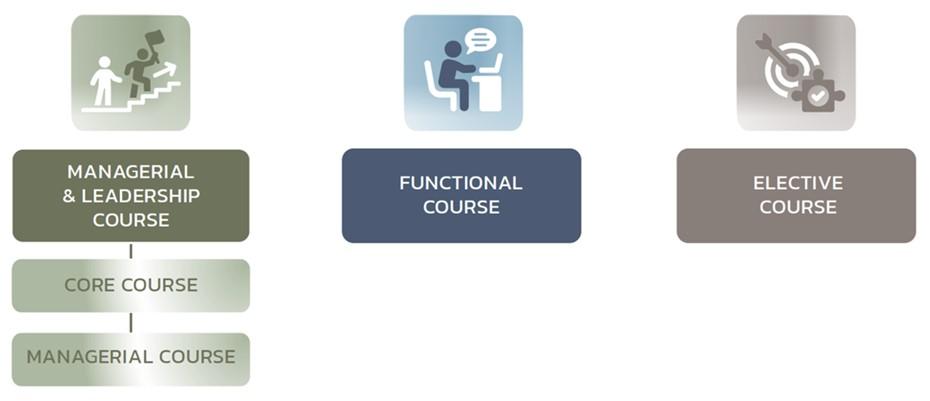
Managerial & Leadership Course
The company developed a training plan to enhance knowledge and skills, focusing on management, team management, and leadership creation to develop leadership competencies to the expected proficiency level. The company's development plan categorizes training courses into two types:
1. Core Course: Focuses on fostering positive attitudes aligned with LPN work standards, such as the LPN Way, Code of Conduct, corporate social responsibility, and participation in organizational sustainability development.
2. Managerial Course: Focuses on developing knowledge, skills, and competencies related to management and coaching, For example, Team Leader Excellence, and The 6 Critical Practices for Leading a Team, among others.
The strategic training plan for managerial courses is divided into four levels:
Development plan for senior executives (Levels 11-13)
Development plan for middle-level executives (Levels 8-10)
Development plan for junior supervisors (Levels 5-7)
Development plan for operational staff (Levels 2-4)
Functional Course Training Plan
The training plan is designed to develop knowledge and skills according to the company's job characteristics, focusing on enhancing knowledge, skills, and competencies relevant to the work. This involves analyzing weaknesses, strengths, past performance results, and essential professional requirements, culminating in a training plan categorized according to key job types, including:
Employee sales potential development
Sales, transfers, listings, and rental services
Project management
Community management
Engineering and Maintenance services
Community Services
Support services
Service standards
Elective Course
This course is designed to enhance the knowledge and skills of employees across various functions, allowing employees to choose to learn about different topics according to their interests. Topics may include safety training, fire safety courses, and legal knowledge related to community management, among others.
Learning Framework of 70:20:10
The company has adopted the 70:20:10 learning framework for planning the development and training of employees, which emphasizes the use of workplace settings (On-the-Job Training - OJT) and social learning from peers to continuously improve and promote the application of knowledge gained in the classroom to the workplace.
70% Learning from Experience (On-the-Job Learning)
Taking responsibility for new projects
Resolving actual work-related issues and participating in job rotation
Undertaking stretch assignments
Engaging in action learning or development projects
20% Learning from Others (Social Learning)
1. Coaching and mentoring
Receiving feedback from supervisors
Team-based working
Participation in Communities of Practice
Sharing best practices across departments
10% Learning from Formal Education (Formal Learning)
Participation in core programs conducted by the L.P.N. Academy / L.P.P. Academy (offline and online)
Learning through the knowledge repository and e-learning platforms
Learning through case studies
Results of Training and Development
In 2025, the company aims to create learning and development opportunities for employees by promoting continuous self-improvement through designated self-learning formats. Employees at various organizational levels are targeted to achieve an average of 26.50 hours of learning and personal development. The distribution of training hours by level and gender is as follows:
Training Hours by Gender Level | Female | Male | ||
Total Training Hours | Average Hours | Total Training Hours | Average Hours | |
1. Senior Executives (Level 11 - 15) | 126.00 | 33.67 | 166.00 | 22.00 |
2. Middle Management (Level 8 - 10) | 1,729.00 | 52.49 | 1,468.25 | 43.23 |
3. Junior Supervisors (Level 5 - 7) | 9,286.00 | 45.37 | 5,421.75 | 37.15 |
4. Operational Staff (Level 1 - 4) | 19,436.00 | 29.40 | 24,086.25 | 27.18 |
5. Community Cleaning Staff | 72,981.00 | 28.00 | 3,322.00 | 22.00 |
Training Hours by Gender Level | Number of People | Total Training Hours | Average per Person |
1. Senior Executives (Level 11 - 15) | 17 | 289 | 33.50 |
2. Middle Management (Level 8 - 10) | 92 | 3,153 | 46.50 |
3. Junior Supervisors (Level 5 - 7) | 512 | 14,353 | 41.00 |
4. Operational Staff (Level 1 - 4) | 3,170 | 43,130 | 26.50 |
5. Community Cleaning Staff | 2,761 | 76,303 | 28.00 |
Gender | Number of People | Total Training Hours | Average per Person |
Male | 1,609 | 28,193 | 28.67 |
Female | 2,182 | 33,548 | 28.67 |
Total | 3,790 | 61,741 | 28.58 |
3. Promotion of Internal Trainer Development Within the Organization
In 2025, The LPN Academy has coordinated weekly employee communication activities, encouraging staff to rotate in roles as live event hosts and content presenters. This system allows employees to share knowledge and experiences, fostering a sense of pride and engagement among those who have the opportunity to participate. The initiative covers various departments, allowing numerous employees to practice and share responsibilities for presenting different content topics, including both managers and staff within the same line of work.
Furthermore, in 2025, The LPP Academy will offer training courses conducted by 123 internal trainers across 453 different courses. These courses are designed to develop skills relevant to the company’s operations and to review existing knowledge. Notably, the primary focus remains on intensive courses led by internal trainers, which include:
- New Staff Preparation Course: Designed to onboard and prepare new employees for their roles effectively.
- Introduction to Community Management and Maintenance Work (CM/P&M New Staff): A foundational course for understanding community management and maintenance operations.
- SERVICE Excellence Standard Course: Training aimed at enhancing service delivery standards within the organization.
- Digital Literacy Course: Focusing on improving employees' digital skills necessary for modern tasks.
- Community Manager Development Course (CMTC): A specialized course to enhance the skills and competencies of community managers.
- Community Management Law Course: Providing insight into legal aspects relevant to community management operations.
- ISO Compliance Training: Educating staff on operational standards as they align with ISO requirements.
- Legal Knowledge in Community Management: Ensuring employees are knowledgeable about the legal framework affecting community management.
- Effective Mentoring & Coaching Course: Aiming to develop mentoring skills among employees for better support of their colleagues.
- Career Development Courses: Tailored programs that support professional growth in various specialized fields.
4. Promotion of Self-Learning through Online Systems (E-Learning)
In 2025, The LPN Academy, in collaboration with the Information Technology Department, has developed the LPN Academy website for employees in the real estate development sector and the LPP Academy website for service business employees. These platforms serve as channels for learning and provide convenience for employees in reviewing knowledge, registering for training, and assessing understanding post-training.
Additionally, the company has enhanced its online system to record knowledge gained from self-learning, continuously improving learning tools through Viva Engage. This enables employees to further develop themselves. The curriculum includes Digital Literacy courses, which employees can access through user-friendly online channels, including on smartphones via the Line OA: LPN Friends and LPP Friends applications. These resources encompass knowledge modules relevant to the real estate business, learning materials focused on service techniques for creating outstanding customer experiences, management knowledge, and job-specific information tailored to each function.
The various courses promote online learning, increasing opportunities for knowledge acquisition and supporting employees in easily accessing learning resources.
5. Development of Signature Courses for Professional Quality Personnel
In 2025, the LPP Academy will implement signature courses aimed at developing professional personnel across different functions to enhance core competencies in leadership, management skills, team dynamics, and service delivery, fostering Service Excellence in the workplace. Each year, the institute creates quality personnel through these signature courses, focusing on community management and value delivery within a unique management system.
In 2025, the institute is set to develop quality personnel through several signature courses, divided as follows:
- Community Management Training Course (CMTC) : 1 session with 30 participants
- Operation & Maintenance Training Course : O&MTC : 1 session with 33 participants
- Service Community Management Training Course (SCMTC) : 1 sessions with 32 participants
- Security Staff Development : 10 sessions with a total of 475 participants
6. Promotion of Basic and Higher Vocational Education through the Dual Education Program
The company collaborates with educational institutions to offer a dual education program aimed at promoting education and providing students with vocational training that aligns with their fields of work. This initiative is designed to enhance students’ work experience prior to graduation, with the goal of preparing youth to enter the labor market equipped with the relevant knowledge, skills, and professional experience. The students are supported by company mentors who provide guidance and continuous assessment throughout the program.
Participants in this program must be students in Vocational Certificate (Voc. Cert.) and Higher Vocational Certificate (Higher Voc. Cert.) programs in relevant trades or service management, which include fields like Electrical Engineering, Electronics, Mechanical Engineering, Office Management, and Business Computing. Since its inception in 2023, the program has seen participation from 165 individuals. The company supports participants with various expenses including:
- Living allowances
- Scholarships
- Accident insurance during training
- Skills training
The company has established partnerships with 22 educational institutions for this dual education program, which include:
1. Kanjanapisek Nonthaburi Vocational College
2. Nawaminthrachuthit Vocational College
3. Sri Samrong Vocational College
4. Minburi Technical College
5. Bangkok Industrial Technology College
6. Rama VI Technology College
7. Siam Technology College (Siam Tech)
8. Prachinburi Vocational College
9. Prachinburi Technical College
10. Rasi Salil Technical College
11. Chitralada Technology College
12. Phra Samut Chedi Vocational College
13. Saraburi Vocational College
14. Khao Wong Technical College
15. Surin Technical College
16. Ubon Ratchathani Technical College
17. Sichol Technical College
18. Sukhothai Technical College
19. Roi Et Technical College
20. Kantharalak Technical College
21. Chethuphon Commercial College
22. Nong Khai Industrial and Community Education College
7. Budget Allocation for Development, Training, and Seminars
In 2025, the company has allocated a total budget of 10,322,156 Baht for the development and operational activities related to training and seminars through the LPN Academy. The budget details are as follows:
Training Center Expenses 7,019,158 Baht
Internal Training Expenses 2,538,511 Baht
External Training Expenses 764,487 Baht
Policy for Promoting Environmenta land Social Responsibility Awareness among Employees
The company operates with a strong commitment to environmental and social responsibility, aiming to cultivate personnel who take pride in and believe in the values of the organization, while contributing positively to society. Therefore, the company has established a clear policy to provide education on environmental and social issues to its employees.
Each year, the development plans and training topics are determined by management and are adjusted to reflect the current socio-political context.
In 2025, the LPN Academy will continue to manage environmental responsibilities and adhere to the 6 GREEN strategy. Regular reports on environmental and social responsibility performance are made according to the LPN Green Standard Checklist.
Additionally, the LPN Academy has invited the Social and Environmental (S&E) department to share knowledge and current environmental situations with employees through seminars and ongoing knowledge-sharing activities. These initiatives are designed to help employees better understand and become more aware of their roles in caring for the environment and society, as well as their responsibilities related to environmental and social practices.
Policy on Anti-Corruption Training and Awareness
The company has implemented a policy concerning anti-corruption measures, requiring board members, executives, and employees of the company and its subsidiaries to comply strictly with these guidelines. Throughout the year, the company provides education and communication to employees regarding corruption in various topics, conducted in the form of training reviews, communications via bulletin boards, and electronic mail (Email), supplemented by knowledge assessments to reinforce the code of ethics in different categories, particularly Category 3: Anti-Corruption. The following initiatives are in place for 2025 :
Training and Review of Business Ethics : Monthly training sessions on business ethics are conducted, especially focusing on new employees.
Quarterly Ethics Knowledge Assessment : Employees are required to complete a review assessment every quarter, ensuring they achieve a passing score across all questions.
Review of the Anti-Corruption Policy : The Anti-Corruption Policy, approved by the Board of Directors Meeting through training sessions included in the orientation program for new employees.
Communication on Whistleblower Protection Policy : The company provides explanations to enhance understanding of the policy for protecting whistleblowers, witnesses, informants, or anyone reporting corruption, illegality, or code of ethics violations, which was also approved by the Board of Directors Meeting through supportive materials and online learning resources for employees regarding the code of ethics.
Furthermore, during the Board of Directors meeting No. 5/2016 on June 21, 2016, the business ethics code was reviewed and approved, taking effect from that date onward, thus superseding the previous business ethics codes for board members and employees established in 2005. The Board also issued announcement regarding guidelines on charitable donations and support funds, aimed at ensuring that the company’s board members and employees act in accordance with ethical principles.
Business ethics have been incorporated into the new employee orientation process since 2022, along with improvements and developments in tools to promote knowledge about ethics and anti-corruption measures, including:
- Online Ethics Review and Training Courses
- Online Ethics Knowledge Assessment Form Each Quarter
- Self-Learning Ethics Video Clips
- Knowledge Repository for Ethics and Review Materials
Plan Areas
| Plan Area |
|---|
| Fair employee compensation |
| Employee training and development |
| Promoting employee relations and participation |
| Migrant/foreign labor |
| Child labor |
| Occupational health and safety in workplace |
Employees — Workforce
Workforce Data
| Metric | Current Year | Previous Year | Two Years Ago |
|---|---|---|---|
| Total number of employees (Persons) | 10,149 | 5,367 | 6,590 |
| Number of male employees (Persons) | 3,584 | 1,285 | 2,164 |
| Number of female employees (Persons) | 6,565 | 4,082 | 4,426 |
| Total employment of disabled persons (people) | 58 | 34 | 17 |
| Total disabled employees (people) | 54 | 34 | 17 |
| Total male disabled employees (people) | 26 | 22 | 10 |
| Total female disabled employees (people) | 28 | 12 | 7 |
| Total disabled workers who are non-employee (people) | 4 | 0 | 0 |
| Contributions to the fund for promoting and improving the quality of life for disabled persons | 1 | 1 | 1 |
| Total number of male employees in operational level (Persons) | |||
| Total number of male employees in management level (Persons) | |||
| Total number of male employees in executive level (Persons) | |||
| Total number of female employees in operational level (Persons) | |||
| Total number of female employees in management level (Persons) | |||
| Total number of female employees in executive level (Persons) |
Employees — Remuneration & Provident Fund
Remuneration & Provident Fund
| Metric | Current Year | Previous Year | Two Years Ago |
|---|---|---|---|
| Total disabled employees (people) | 1,934,085,433.81 | 1,234,819,701 | 898,621,102 |
| Total male employee remuneration (Baht) | 778,526,279.67 | ||
| Total female employee remuneration (Baht) | 1,155,559,154.14 | ||
| Number of employees eligible to participate in PVD (persons) | 1,752 | 1,916 | 1,504 |
| Total number of employees joining employee provident fund (Persons) | 1,661 | 1,916 | 1,504 |
| Percentage of total number of employees joining employee provident fund to total number of employees (%) | 16.37 | 35.7 | 22.82 |
| Number of PVD members / Total eligible employees (%) | 94.81 | 100 | 100 |
| Total amount of provident fund contributed by the Company (Baht) | 32,704,480.27 | 28,161,870 | 27,349,578 |
| Total amount of provident fund contributed by employee (baht) |
Employees — Training & Development
Training Data
| Metric | Current Year | Previous Year | Two Years Ago |
|---|---|---|---|
| Average employee training hours (Hours / Person / Year) | 26.5 | 30 | 34.29 |
| Employee development and training expenses (baht) | 10,322,156 | 10,308,606 | 8,616,454 |
Employees — Occupational Health & Safety
Occupational Health & Safety Data
| Metric | Current Year | Previous Year | Two Years Ago |
|---|---|---|---|
| Total number of lost time injury incidents by employees (Cases) | 51 | 22 | 31 |
Employees — Labour Relations
Labour Relations Data
| Metric | Current Year | Previous Year | Two Years Ago |
|---|---|---|---|
| Total voluntary resignations (Persons) | 3,537 | 2,409 | 2,520 |
| Male employees who voluntary resigned (Persons) | 1,359 | 1,297 | 1,404 |
| Female employees who voluntary resigned (Persons) | 2,178 | 1,112 | 1,116 |
| Percentage of employee turnover leaving the Company voluntarily (%) | 34.85 | 44.89 | 38.24 |
| Evaluation result of employee engagement | 0 | 0 | 0 |
Employees — Employee Representation
Employees Are Represented Collectively
Yes
Forms of Representation
| Form |
|---|
| Welfare committee |
Employees — Targets
Has Set Employee Targets
Yes
Targets
| Indicator | Target Areas | Target Year | Target Year — Description |
|---|---|---|---|
| Training Hours | 2984 · Description: Employee training and development · 2983 · Description: Fair employee compensation · 2985 · Description: Promoting employee relations and participation · 2986 · Description: Migrant/foreign labor · 2987 · Description: Child labor · 2988 · Description: Safety and occupational health at work · 2989 · Description: Non-discrimination | 2,025 | 26.50 hrs./person/year |
Employees — Performance & Outcomes
Has Performance Results
Yes
Performance Description
In 2025, the company aims to create learning and development opportunities for employees by promoting continuous self-improvement through designated self-learning formats. Employees at various organizational levels are targeted to achieve an average of 26.50 hours of learning and personal development.
Customers — Plan & Guidelines
Has a Customer Management Plan
Yes
Plan Description
GREEN MARKETING MANAGEMENT
The marketing strategy of the Company is designed to be in accordance with our determination to build the first high quality home at affordable price for the middle tolower- middle income earners in order to create a great quality of life and society for the residents in a responsible manner both before and after project handover. The marketing policy of the Company is fair, respects consumers’ right and treats the competitors with fairness. The 6Ps Marketing Strategy is as follows:
Product Strategy
The Company strives to deliver unique productvalues both in condominium units and commonarea to the customers. The product values aredeveloped from knowledge and experiencesin project development to accommodate thelifestyle of the residents.
Price Strategy
By managing costs and expenses in allproduction processes, the selling price of theproduct is affordable and competitive. The profitand terms and conditions of the installmentpayment for down payment are determined in linewith the status of the target group. The Companyalso provides financial management services tocustomers to facilitate their loan application andcreate an opportunity for them to own a home.
Place Strategy
The location of the sales office must be on ornear project development site so that it wouldbe accessible to the customers. All the detailsmust clearly be stated and easy to understandwithout any hidden agendas.
Promotion Strategy
In conducting sales promotion, the Companytakes the benefits of customers and the Companyinto account. The sales conditions are fairand clear. The advertisement is creative with nohidden agenda.
People Strategy
The Company gives a great deal of importanceto customers’ satisfaction. The standardof touch points e.g. sales officer, maid andsecurity officer has been established andtrainings which are in accordance with LPNService Culture (S-E-R-V-I-C-E-S) areprovided on a regularly basis to bring aboutpositive customer experiences and build upsales volume from referral. The net promoterscore (NPS) measuring customer loyalty isthe guarantee for after-sale services. Thereare also various channels for submissionof complaints and suggestions for serviceimprovement.
Process Strategy
All processes must provide convenience forcustomers. The reservation making andcontract signing processes must besimple and speedy. Various paymentchannels and methods must be in place.The deposit forfeit and return must be consideredcarefully and consider the concerns ofcustomers. Also, the Company makes an attemptto minimize complaints arising from highexpectations of customers by highlightingimportant issues in the reservation agreementand communicating with customers for mutualunderstanding.
Plan Areas
| Plan Area |
|---|
| Responsible production and services for customers |
| Communication of product and service impacts to customers/consumers |
| Development of customer satisfaction and customer relationship |
| Protection of customer personal information |
Customers — Satisfaction Results
Customer Satisfaction Results
| Metric | Current Year | Previous Year | Two Years Ago |
|---|---|---|---|
| Evaluation results of customer satisfaction | 1 | 1 | 1 |
Customers — Targets
Has Set Customer Targets
Yes
Targets
| Indicator | Target Areas | Target Year | Target Year — Description |
|---|---|---|---|
| revenue | 3007 · Description: Responsible production and services for customers | 2,025 | The Company emphasizes developing products and services that align with customer insights by using Big Data to analyzing customer
behavior and needs and adjusting its project development models to meet the demands of new generation. In 2025, the Company plans to
launch four new projects two residential condominium projects and two residential home projects with a combined value of approximately
6 billion baht, in response to the current purchasing behavior of consumers. |
Customers — Performance & Outcomes
Has Performance Results
Yes
Performance Description
LPN won a “People’s Choice Award” at the PropertyGuru ThailandProperty Awards 2024, an award where the general public votesfor their favorite real estate developers. LPN was recognizedas one of the top 10 most-voted companies by consumers,reflecting trust in the quality of the Company’s products andservices. This reinforces LPN’s position as a beloved residentialbrand among consumers
Community & Social — Plan & Guidelines
Has a Community & Social Plan
Yes
Plan Description
GREEN COMMUNITY MANAGEMENT
Management of Quality of Life of Residents after Handover
The responsibility of real estate developers should not be ended when the“residence” is handed over to the customers. The building and environment shouldalso be managed and maintained afterwards. However, the Company has realizedthat there are more to project development and thus developed building managementguideline and community management strategy to promote gracious culture andharmony of living together in the society.
During the past 35 years, the Company has created and handed over a “home” to members of more than 130,000 “Lumpini”families and taken care of the environment and quality of life of the residents and neighboring communities via “Livable Home” strategy.The Company does not only ensure the safety and standard of the equipment but also the safety of the community, the happiness ofthe residents as well as environmental awareness of the residents on a regularly basis in accordance with the F-B-L-E-S+P guideline.It is developed from extensive community management experiences with the aim to deliver a great quality of life, environment andsociety to the residents. The details are as follows:
FACILITY MANAGEMENT
It is to maintain the efficiency of common propertiesincluding facility usage management during theCovid 19 outbreak. There must be cleanlinessstandards and social distancing while using, nomatter they are architectural structure, convenientfacilities or various systems in the building e.g.elevator, electricity generator, electrical system andsanitation system, to ensure that all componentsof the building function normally and are safe tooperate.
BUDGETING MANAGEMENT
It involves the management of budget forcondominium juristic person to be in line withthe policy approved by the Annual General Meetingof Joint Owners as well as the managementof the stability of the fund for the financial stabilityof the community. A financial report that is easyto understand, transparent and auditable will alsobe prepared.
LIFE QUALITY MANAGEMENT
It is the management of the quality of life ofresidents encouraging them to comply withthe regulations of condominium and single home,ensuring their comfort and convenience and issuingCOVID-19 prevention measures in the residentialarea. This is to entail the harmony of living togetherhappily and “Togetherness, Care and Share”culture. Various activities are organized tobuild good relationship within the family and forcommunity development among “Lumpini”members.
ENVIRONMENT MANAGEMENT
The Company puts very much emphasis onenvironmental issues. Green Clean Lean conceptis promoted and various activities are implementedsuch as tree planting activity, increase ofgreen space in the community and neighboringcommunity, waste segregation program, effectiveinfectious waste disposal, waste water treatment,reuse of treated waste water in the project,energy conservation campaign and promotion ofrenewable energy.
Plan Areas
| Plan Area |
|---|
| Employment and professional skill development |
| Education |
| Occupational health, safety, health, and quality of life |
| Disadvantaged and vulnerable groups |
Community & Social — Targets
Has Set Community & Social Targets
Yes
Targets
| Indicator | Target Areas | Target Year | Target Year — Description |
|---|---|---|---|
| Unit of the Projects "“Livable Community For All” | 3041 · Description: Occupational health, safety, health, and quality of life | 2,025 | under “Livable Community For All” strategy with an aim to
create a good quality of life for the residents and be responsible
for the environment and society. |
Community & Social — Performance & Outcomes
Has Performance Results
Yes
Performance Description
Following the earthquake in Bangkok on 28 March 2025, the Company received praise from residents of projects managed by LPP Property Management Co., Ltd. (LPP), a subsidiary of L.P.N. Development Public Company Limited. Employees and executives of the Company and its subsidiaries, together with business partners who are regarded as LPN Team as a trusted partners, worked closely and wholeheartedly to alleviate the impact and assist customers. As a result, co-owners and residents were able to safely return to their condominium units within six hours after the earthquake.
The Company also continued to conduct safety inspections covering both structural elements and building systems. Engineering teams were deployed to inspect condominium projects developed by the Company, including completed projects and those currently on sale. In addition, the Company cooperated with co-owners in arranging certified building inspectors to assess any damage and evaluate building safety, with the results reported within two weeks in accordance with the policy of the Bangkok Metropolitan Administration.
The strength of the Company’s stakeholder network during an emergency and its timely response demonstrate the quality of its project management and its responsibility towards society, customers, and the Lumpini community, supporting the continued development of “Livable Community” for the past 37 years.
Law Violation Incidents
Law Violation Incidents
| Metric | Current Year | Previous Year | Two Years Ago |
|---|---|---|---|
| The total number of cases or incidents of significant violations of laws or regulations regarding social and human rights (Cases) | 0 | 0 | 0 |
| The total number of cases or incidents that cause significant labor disputes (Cases) | 0 | 0 | 0 |
| The total number of cases or complaints related to consumer rights violations (Cases) | 0 | 0 | 0 |
| The total number of cases or complaints related to partner rights violations (Cases) | 0 | 0 | 0 |
| The total number of cases or incidents that cause disputes with the community/society (Cases) | 0 | 0 | 0 |
| The total number of cases or incidents related to cyber security or customer data breaches (Cases) | 0 | 0 | 0 |
| The total number of cases or incidents related to safety and occupational health at work (Cases) | 0 | 0 | 0 |